Saturday, October 18, 2008

Mrs. Rosa's dahlias


This is the daughter of Mrs. Rosa Hicks of Banner Elk, N.C., standing next to her mother's dahlias at a family reunion. Rosa is the widow of famed storyteller Ray Hicks. Mrs. Hicks and her flowers are a treasure. I interviewed her for a 2007 magazine article, excerpted here:
Rosa Hicks, 76, who has lived her life in the high country of Avery County, was one of the North Carolina farm women immortalized in Lawrence's book "Gardening for Love: The Market Bulletins," published after the author's death. Hicks has advertised in the N.C. Agricultural Review for more than 50 years, and still sells dahlias through the mail and at her house on Old Mountain Road in Banner Elk. Her offerings from the 1950s and 60s read like an encyclopedia of North Carolina's treasured wildflowers: Dutchman's breeches, Ladyslippers, trilliums, bellworts, trout lilies, mayapples and galax.

"Mostly all the flowers we advertised were around the house on our place," she said. "But some we had to go to the woods to get." Back then, Hicks swapped plants with "other flower lovers" and sometimes bartered for printed feed sacks, which she used to sew pillowslips and children's shirts and dresses. Though she enjoyed trading plants and says it sometimes felt like a hobby, the money she earned was—and still is—a vital source of household income.

Elizabeth Lawrence also wrote a passage about Ray Hicks and his thoughts on snakebite.
"People don't understand snakebite," he said. "There are herbs for it, but turpentine and whiskey are the surest cures." He knows a man who has three scars on his face and twelve on his legs from being bitten when he was gathering ginseng. "He never goes where snakes are without taking three bottles of turpentine and a pint of pure good whiskey with him. When a snake strikes he pours the turpentine on the wound, a bottle at a time, until all the poison is drawn out. Then he drinks the whiskey and lies down. If you drink the whiskey first it will kill you."
You can read some of the memories of Ray and Rosa Hicks here.

Mrs. Hicks' flower trade is pretty informal. There are no fancy catalogs. I mailed her $15 last year and asked her to send me as many dahlia tubers as she'd like for that price. I received quite a few fat ones in great condition. They were mixed, so I had to wait for them to bloom to see how they'd look. I know that's not for everyone, but I like to be surprised. And knowing how long they've been in her family makes it extra special.

Should you wish, you may write to her to inquire about her flower sales: Rosa Hicks, 218 Old Mountain Road, Banner Elk, NC 28604.

Friday, October 10, 2008

Wednesday, October 8, 2008

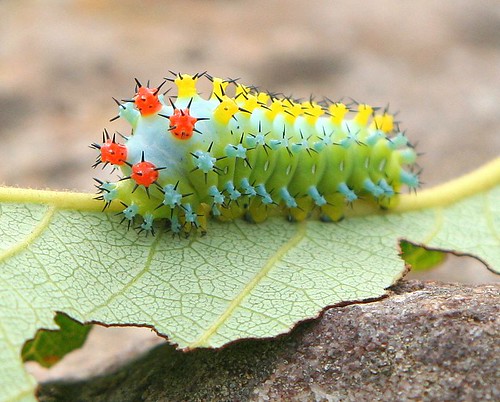
Cecropia moth caterpillar


This is one of several caterpillars I raised on sweetgum leaves a few summers ago. Wish I had gotten a better photo, but at least you can see the beautiful colors. An entomologist offered to give me some this year, but they'd already been started on sour cherry and were large enough that he doubted they'd make the transition to sweetgum. I didn't have access to cherry. I'll let you in on a little secret. I don't have a sweetgum tree either. But there's one behind a fast food restaurant not too far from here. That's where I "borrowed" the branches when I was raising this guy. There's a much better and more dramatic photo of a cat here and an adult here.

Tuesday, October 7, 2008

Monday, October 6, 2008

Armchair traveler: the Canadian Rockies


My friend Tracy likes to live large. While on a business trip to Calgary last week, he took a spur trail to Banff National Park and points beyond.

Word of the Day: "katabatic wind," which means, says he, "a [expletive] cold wind that blows off a glacier"!

Photos, copyright 2008, Tracy Fulghum
[top] Sunrise in Banff from the 9-1/2 floor of Banff Springs Inn
[bottom] Lake Agnes (he thinks) near Lake Louise

Saturday, October 4, 2008

Abandoned macaque finds a friend


I think this might be one of the most poignant photos I've ever seen. Click on the image for the whole story.

Friday, October 3, 2008

Grandfather Mountain still in good hands


One of the biggest environmental success stories in North Carolina this year is the announcement Monday that Grandfather Mountain has been purchased by the state. Put up for sale recently by the heirs of Hugh Morton, the mountain and surrounding wilderness areas will become the home of North Carolina's newest state park—2,601 acres!

A steal at $12 million, Grandfather Mountain is not only a state treasure, it is a national and world treasure. Designated an International Biosphere Reserve, the mountain and its backcountry contain 16 distinct ecological communities and 73 rare and endangered species, including the Rafinesque's big-eared bat, Carolina northern flying squirrel, bog turtle and Appalachian yellow-bellied sapsucker.

Tourists know Grandfather Mountain for its most famous attraction, Morton's Mile High Swinging Bridge. When I was a tot, that bridge scared the daylights out of me, but on my most recent visit, I was able to walk (with trepidation) to the middle before turning back. Another beloved attraction was the late Mildred the Bear. The Morton family will continue to operate the tourist attraction through a nonprofit organization supported by money from the sale.

We have Hugh Morton to thank for his conservation ethic and stewardship of Grandfather Mountain. And we have his heirs to thank for selling to the State of North Carolina, at a bargain, a chunk of land that would make billionaire developers weak in the knees.

Thursday, October 2, 2008

Paperbird

I know many of my wonderful neighbors, but I'm not always aware of all their unique talents. Yesterday I discovered that Debra, who lives down the street from us, makes and sells beautiful handmade paper goods. An artist and ecologist, she creates whimsical cards, albums, journals and other crafts with nature themes. You can view (and purchase) Debra's wonderful work via her Web site, Paperbird. She also does custom designs and orders. Pop in for a visit. I think you'll like it!

Eastern bluebird
copyright 2008
Debra Shore

Wednesday, October 1, 2008

Gulf fritillary caterpillar


Found this gulf fritillary caterpillar crawling on my hops vine one night last week. The passionflower vine—the host plant for the larvae of gulf fritillary butterflies—is nearby. I had not realized that anything was feeding on it (we're talking serious vine traffic jam—moonflower, hops, passionflower and butterfly vine), so I was excited to find this caterpillar looking for a place to make that final molt (they usually travel away from the host plant once they're "full up").


.... and so ......... the next day I found the caterpillar in its "J" stage—hanging underneath our front porch awning. If you click to enlarge the photo, you'll see something going on around its head. I think these guys shed head-first, so I figured this was the beginning of the molt (or a serious case of the ick). We had a cold snap and it stayed like this for about a day.

Tuesday, September 30, 2008


And on the third day: Houston, we have pupation!

Tuesday, September 16, 2008

The cat alarm clock, a work in progress

In theory, a cat toy could make a great alarm clock. That is, if your cat jumped on the bed precisely at the time you desired to wake up every morning and started batting his toy around the foot of the bed. As most cat owners know, this is almost never going to happen.

Not only is my "jingly-bell feather" alarm highly variable, it is very hard to turn off, and there is no snooze feature. In the throes of sleepiness, my solution is a little sleight-of-hand. I snatch the toy and quickly stash it under my pillow. Max is baffled and rather quickly exits the mattress.

IF you could set the alarm for the same time every morning and IF you could develop reliable snooze technology (getting up, throwing the toy down the hallway, then waiting for the cat to bring the toy back to the bed exactly 9 minutes later), then the cat alarm clock would surely be a hot ticket item. The folks in R&D should get right on that.

For some non-feline related snooze button lore and advice, read on:

Why are snooze alarms on a 9-minute cycle, rather than a more logical 10-minute increment?

Jeff Elder at Jewish World Review offers one answer: "By setting the snooze time to 9 minutes, modern digital alarm clocks only needs to watch the last digit of the time. So, if you hit snooze at 6:45, the alarm goes off again when the last digit hits 4 — at 7:54. They couldn't make the snooze period 10 minutes, or the alarm would go off right away — or the clock would take more circuitry."

And how many of us actually use the snooze?

More from Elder: "If you smack a snooze button, you ain't sleepin' alone. According to USA Today, more than a third of American adults hit the snooze button every morning an average of three times. Snooziest group? The 25- to 34-year-olds — 57 percent of them hit the snooze button daily. Peppiest risers? It's the seniors. Only 10 percent of Americans over 65 regularly use their snooze button."

For those who can't resist postponing their day just a little longer, psychology professor Ken Carter has this advice:

"I always tell my students to avoid the snooze at all costs! It's basically forcing yourself to relive the worst part of your day over and over and over again."

Oh, Dr. Ken. You feel my pain.

Monday, September 15, 2008

Japanese anemone


The first time I've ever had a Japanese anemone bloom before I killed it! This one's happy as can be, in fairly moist 2/3 shade, keeping company with an ostrich fern.

Friday, September 12, 2008

Hurricane Carla revisted

Hurricane Carla, for whom I am not named, slammed the Texas coast Sept. 11, 1961, and at least for now, holds the record for the highest storm surge in the Lone Star state. Writes Jeff Masters' at Weather Underground: Carla was a Category 4 hurricane with 145 mph winds at landfall, and drove a 10 foot or higher storm surge to a 180-mile stretch of Texas coast. A maximum storm surge of 22 feet was recorded at Port Lavaca, Texas. Despite the fact that the center of Carla hit over 120 miles southwest of Houston, the hurricane drove a 15-foot storm surge into the bays along the south side of the city.

Curiosity compelled me to learn more about the hurricane with my name. I found a colorful recollection of Carla by Texan Adela Kutch Farley, who was 31 years old at the time. When the stormwaters sucked their back door from the hinges, her husband Virgil shored up the front door with boards to keep the cows on the porch from smashing in. Adela, Virgil, the kids and the dog made for the attic, where they braced against the spray of saltwater through the roof vents. After the storm, rattlesnakes were everywhere, she said, "blinded by saltwater." "I hope and pray Carla was the 100-year-hurricane for us," she wrote in a special storm retrospective in the Jan. 6, 2005 online edition of the Palicios Beacon.

Though the "during" and "after" parts of Farley's account are evocative, my favorite anecdote is about her pre-storm restlessness. A woman after my own heart, Adela started cooking.
"Sunday night before Carla came in, I couldn't sleep, so I got up and started frying chicken and baked two cakes, as I knew we would be without electricity and water. When I turned the kitchen light on, I was met by millions of ants on the cabinet and crawling up the wall on both sides of the window, up to the attic. Were the ants trying to tell me something? I sprayed and sprayed everywhere, cleaned them up and started cooking."
If my math is correct, and if she is still alive, Mrs. Farley is around 77 now. Judging from my map, Palicios, known as "The City by the Sea," looks to be smack dab at the halfway point between Galveston and Corpus Christi. As Hurricane Ike approaches, mandatory evacuation has been issued for Palicios. I hope Mrs. Farley is far from there.

An interesting TV footnote:
All those intrepid (or foolish) wind-battered reporters who must suffer the obligatory "seaside report" have Dan Rather to thank. Says Wikipedia: Then little-known newsman Dan Rather reported live from the Galveston Seawall during the storm, an act that would be imitated by later reporters. Hurricane Carla marked the first live TV broadcast of a hurricane: "Our graphics were a little unpolished, but that day we did something that had never been done before: put a live radar image of a hurricane on television," said Rather.


Photo of Hurricane Carla aftermath from MSNBC archive
I.D. of woman unknown

Mexican sunflower & bengal tiger canna